Text
5 JUNE – 25 JULY
My life is a collage, with time cutting and arranging the materials and laying them down, overlapping and contrasting, sometimes with the fresh shock of a surrealist painting.
– Eileen Agar, 1988
Alison Jacques is delighted to present our first exhibition of Eileen Agar (b.1899, Buenos Aires; d.1991, London) since announcing European representation of the Estate of Eileen Agar.
Eileen Agar was one of the most distinctive figures associated with British Surrealism. Among the few women included in the landmark International Surrealist Exhibition at the New Burlington Galleries, London (1936), she went on to participate in now-legendary international exhibitions, including Fantastic Art, Dada, Surrealism at the Museum of Modern Art, New York (1937), and 31 Women at Peggy Guggenheim’s Art of This Century, New York (1943). In 2021, the Whitechapel Gallery, London, presented Angel of Anarchy, a major retrospective of Eileen Agar’s work comprising over 150 works, curated by Laura Smith, followed by A Look at My Life, a new edition of Agar’s long-out-of-print autobiography, published by Thames & Hudson, and first printed in 1988, which tells the story of her extraordinary life.
Throughout her career, Agar developed an artistic language that resisted fixed stylistic categories, moving fluidly between Surrealism and Abstraction: ‘Abstract art and Surrealism were the two movements that interested me most, and I see nothing incompatible in that, indeed we all walk on two legs, and for me, one is abstract, the other surreal – it is point and counterpoint.’
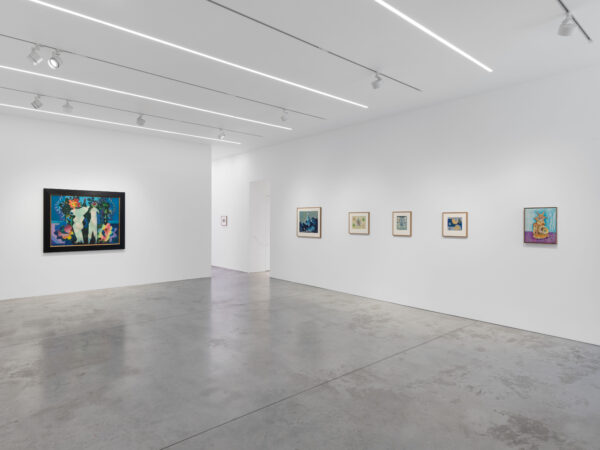
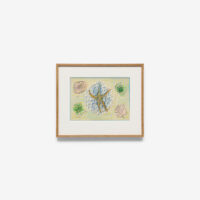
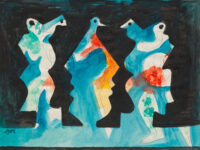
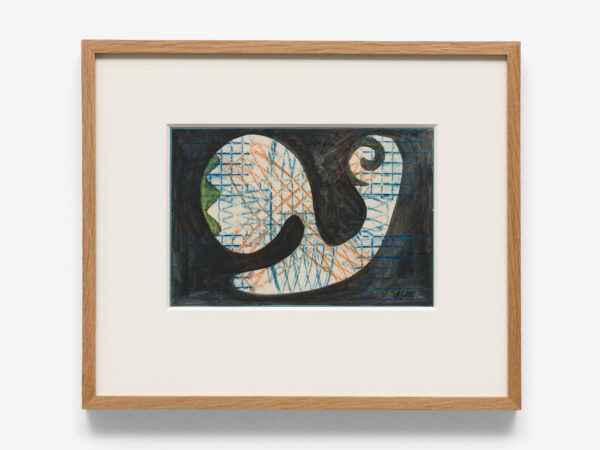
This exhibition brings together paintings and collages spanning almost 30 years of Agar’s career (1957–1985), and a significant theme within the show is her fascination with nature. Following the Second World War, Agar described herself as emerging from a period of ‘physical and spiritual famine.’ Journeys to Tenerife, Cornwall and the Lake District helped replenish what she described as a depleted imagination, and her post-war works reveal a cautious optimism through softer, pastel palettes, layered surfaces, and stencilled forms that gesture towards renewal after years of austerity. Her later paintings from the 1970s and 1980s combine translucent colour, geometric patterns, and recurring motifs, including shells, birds, hands, flowers, and silhouetted figures, often with double facial profiles.
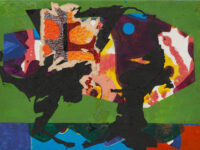
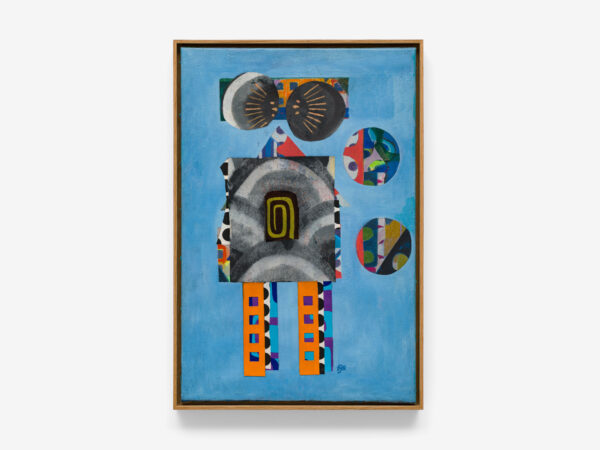
Agar’s work from the 1960s onwards demonstrates her increasingly experimental painterly language, particularly following her embrace of acrylic paint. Introduced to the medium in 1965, acrylic allowed her to combine impasto, washes, and sharply defined forms within ambitious compositions and a continuous spirit of exploration that evolved well into her eighties.
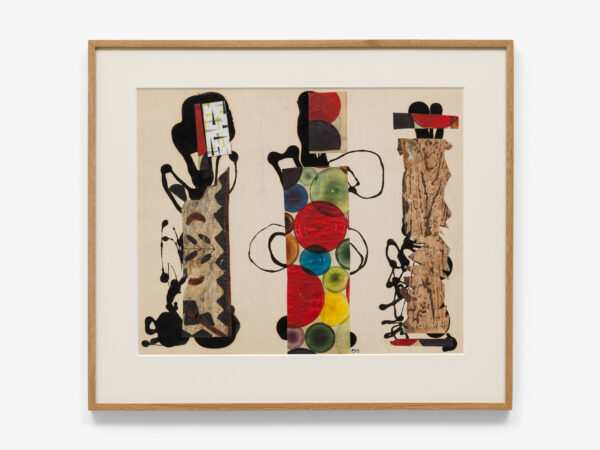
Collage consistently occupied a central role in Agar’s thinking and methodology, functioning as a conceptual framework even within her paintings, allowing forms to dissolve, overlap, and reassemble in rhythmic, organic compositions. As her friend, writer Andrew Lambirth observed, her work ‘is not the spontaneous outpouring of the surrealist unconscious, but a very conscious and highly structured process. It is the Agar way.’ Intuition and imaginative freedom remained fundamental to her practice, as she reflected in 1988, ‘Life’s meaning is lost without the spirit of play. In play all that is lovely and soaring in the human spirit strives to find expression.’
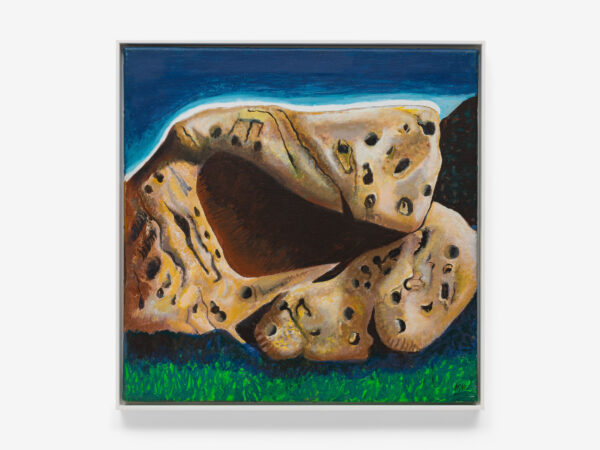
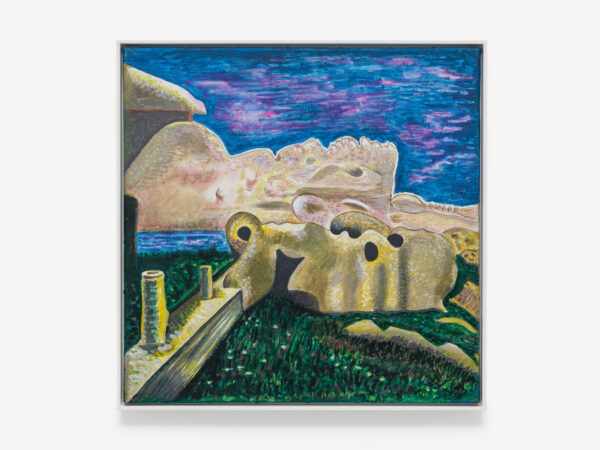
One room of the exhibition focuses entirely on 1985, the year in which Agar returned to photographs which she had taken nearly fifty years earlier in Ploumanac’h, Brittany. Famous for its surreal pink granite boulders along the coastline, Ploumanac’h’s bizarre rock shapes, sculpted over millions of years by wind and sea, further fuelled Agar’s imagination. Referring to her photographs, she created a series of hallucinatory paintings in which the coastal rock formations re-emerge as looming, anthropomorphised presences resembling animals, mushrooms, and faces. Reinterpreting the earlier images through paint with bold colour and shifting perspective, the ‘Rock’ series became a remarkable late expression of Agar’s surrealist imagination, reconnecting memory, nature, and the unconscious across decades of her practice.
In recent years, Agar’s work has been included in international institutional shows, including The Milk of Dreams, curated by Cecilia Alemani, at the 59th Venice Biennale (2022); Surrealism Beyond Borders at the Metropolitan Museum of Art, New York (2021), which travelled to the Tate Modern, London.
Whether dancing on the rooftops in Paris, sharing ideas with Pablo Picasso, or gathering starfish on the beaches of Cornwall, Eileen Agar transformed the everyday into her own magical and otherworldly beauty. Beyond her legacy as a pioneering figure in the Surrealist movement, her identity as a singular artist continues to grow. This exhibition seeks to show how Agar evolved beyond the compartmentalisation of a specific art movement to create her own unique language, which endures today.
This exhibition coincides with Eileen Agar: Leaves of the World at Andrew Kreps Gallery, New York, until 20 June.
Works


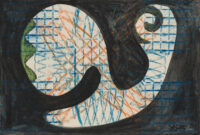
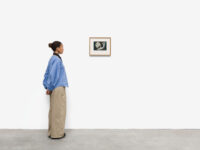









-
![]() Untitled (rock shapes), c.1936
Untitled (rock shapes), c.1936 -
![]() The Sea (the coast at Eastbourne), 1950
The Sea (the coast at Eastbourne), 1950 -
![]() Untitled, 1957
Untitled, 1957 -
![]() Shells and Starfish, 1957
Shells and Starfish, 1957 -
![]() Sleeping sickness, c.1960
Sleeping sickness, c.1960 -
![]() 3 Totems, 1964
3 Totems, 1964 -
![]() People in a Wood, c.1968
People in a Wood, c.1968 -
![]() Untitled, 1969
Untitled, 1969 -
![]() Untitled (Figures/Faces), 1972
Untitled (Figures/Faces), 1972 -
![]() Man in Nature, 1972
Man in Nature, 1972 -
![]() Untitled (Four Forms), 1973
Untitled (Four Forms), 1973 -
![]() Robotics, 1978
Robotics, 1978 -
![]() Profile, 1979
Profile, 1979 -
![]() The Swimming Pool, 1979
The Swimming Pool, 1979 -
![]() The Sleep Walkers, 1979-81
The Sleep Walkers, 1979-81 -
![]() Study for Marine sculpture, 1984
Study for Marine sculpture, 1984 -
![]() Rock 2, 1985
Rock 2, 1985 -
![]() Rock Series, 1985
Rock Series, 1985 -
![]() Rock 1, 1985
Rock 1, 1985 -
![]() Rock 12, 1985
Rock 12, 1985 -
![]() Hidden Lovers of Ploumanach 2, 1985
Hidden Lovers of Ploumanach 2, 1985 -
![]() Rock 3 (Hidden Lovers of Ploumanach 1), 1985
Rock 3 (Hidden Lovers of Ploumanach 1), 1985 -
![]() Bum and Thumb Rock, Ploumanach, 1985
Bum and Thumb Rock, Ploumanach, 1985












Installation