Text
PACITA ABAD SOLO PRESENTATION
FRIEZE MASTERS | BOOTH S19
REGENT’S PARK, LONDON | 14 – 18 OCTOBER
VIP DAYS: 14 – 15 OCTOBER
Alison Jacques is pleased to present Pacita Abad (b.1946; Batanes, Philippines; d.2004, Singapore), marking the eightieth anniversary of Abad’s birth and the announcement of a major European retrospective tour, opening at the Museo Nacional Centro de Arte Reina Sofía, Madrid, in July 2027.
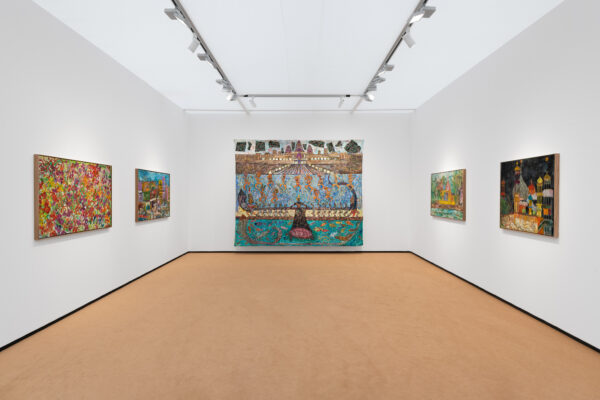
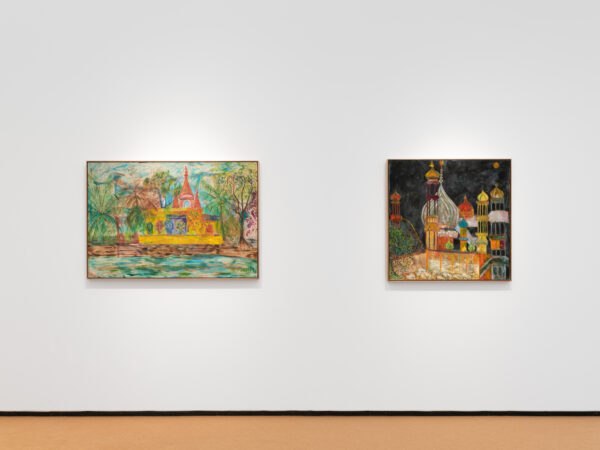
Our presentation focuses on Abad’s Social Realism paintings of the late 1970s and early 1980s, which reveal her sustained attentiveness to people and place, and to the communities, histories and conditions that shape them.
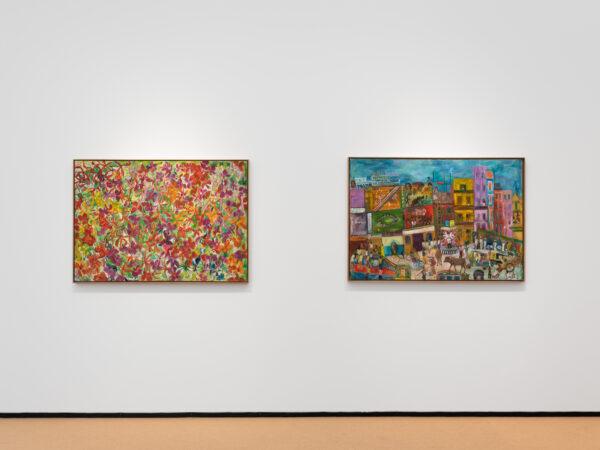
In 1978, while living in Bangladesh, she travelled through the country, painting the landscapes and people of its cities and villages, including Old Dhaka, 1978, which captures the city’s energy and colours. Abad reflected: ‘Dacca is old, but Old Dacca is even older and continues. My first week in the country, I took a rickshaw to Chawk Bazar as an introduction to the city. The overwhelming effects of people, oxcarts, cows, goats, geese, chicken, children, smoking buses casually wandering along the streets were enough suggestions to familiarise oneself of my new environment.’
Operating at times more as a correspondent than an artist, she met journalists reporting on the Teknaf refugee camp and learnt of the plight of Rohingya refugees fleeing Burma (now Myanmar). She later travelled to the Chittagong Hill Tracts, where she spent time with the Chakma people. These encounters deepened her engagement with communities affected by displacement and conflict. Seeking to ‘shun the dramatic and emphasise the human side of the refugees’ through imagery grounded in ‘facts and honesty’—an approach curator Nancy Lim characterises as showing ‘feelings rather than sentimentality’—Abad reflected: ‘What I expected was misery, but there was so much more beyond that.’
Recognising parallels between Chakma textiles and those of the Indigenous peoples of the northern and southern Philippines, Abad began to consider the cultural significance of textile traditions across Asia. Later, during a visit to a Tibetan refugee camp in Nepal, she encountered monks rolling and carrying painted and appliquéd Buddhist thangka paintings, an experience that informed her incorporation of Indigenous material traditions into her artworks.
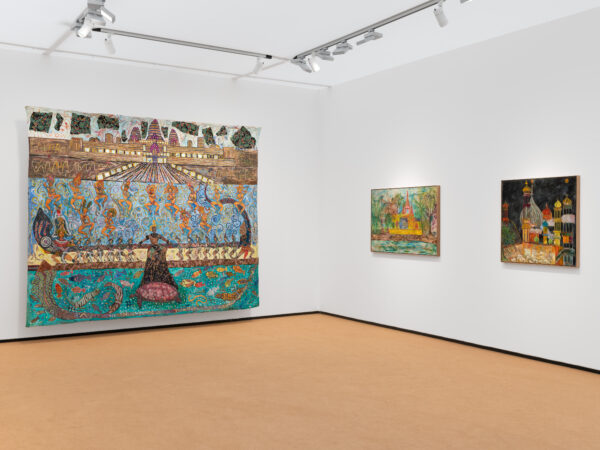
A highlight of the Frieze Masters presentation is Angkor Wat, 1998, a large-scale trapunto painting depicting the historic Hindu–Buddhist temple in Siem Reap, Cambodia, on display for the first time. Produced in conversation with her paintings of Cambodian refugees, which will form a focal point of the forthcoming retrospective, this singular work underscores Abad’s celebration of culture alongside her unflinching depiction of the lived realities of refugees and immigrants.
From the early 1980s, Abad developed her trapunto paintings, in which she stitched and stuffed painted canvases to create quilted, three-dimensional surfaces, often embellishing them with fabric, beads, buttons, sequins, shells and mirrors. They bring painting, textile and sculptural relief together, transforming the materials and techniques encountered during her travels into an exuberant and highly individual visual language.
Colour provides a continuous thread across Abad’s practice. As American painter and author Faith Ringgold observed, ‘Widely travelled, Abad creates her work from the point of view of an international woman of color.’ Ringgold’s description captures the multiple meanings of colour within Abad’s work: as an expression of identity, as a response to the diverse visual cultures she encountered, and as a defining element of her artistic language. Reflecting on her contribution to American art, Abad declared: ‘Color! I have given it color!’ Moving between countries and artistic traditions, her work resisted any single geographical, stylistic or cultural definition. Over her lifetime, Abad visited sixty-two countries and lived in eleven. Her travels spanned Asia, Africa, the Middle East, Latin America, Europe and the United States.
Abad’s first major retrospective in North America, curated by Victoria Sung with Matthew Villar Miranda, was presented at the Walker Art Center, Minneapolis; San Francisco Museum of Modern Art; MoMA PS1, New York; and the Art Gallery of Ontario, Toronto, between 2023 and 2025. The European retrospective will open at the Museo Nacional Centro de Arte Reina Sofía, Madrid, from 8 July 2027 to 10 January 2028, before travelling to Mudam, Luxembourg, and then to EMMA–Espoo Museum of Modern Art, Finland.
Abad’s work is held in international museum collections including Galeri Nasional Indonesia; Guggenheim Abu Dhabi; Jameel Art Center; M+, Hong Kong; The Metropolitan Museum of Art, New York; The Museum of Modern Art, New York; National Gallery Singapore; the National Museum of the Philippines, Manila; National Museum of Women in the Arts, Washington, DC; San Francisco Museum of Modern Art; Smithsonian American Art Museum, Washington, DC; Stedelijk Museum, Amsterdam; Tate, London; Walker Art Center, Minneapolis; and Whitney Museum of American Art, New York.
Installation