

Sky Glabush: Painting’s Alphabet
Border Crossings
January 2025

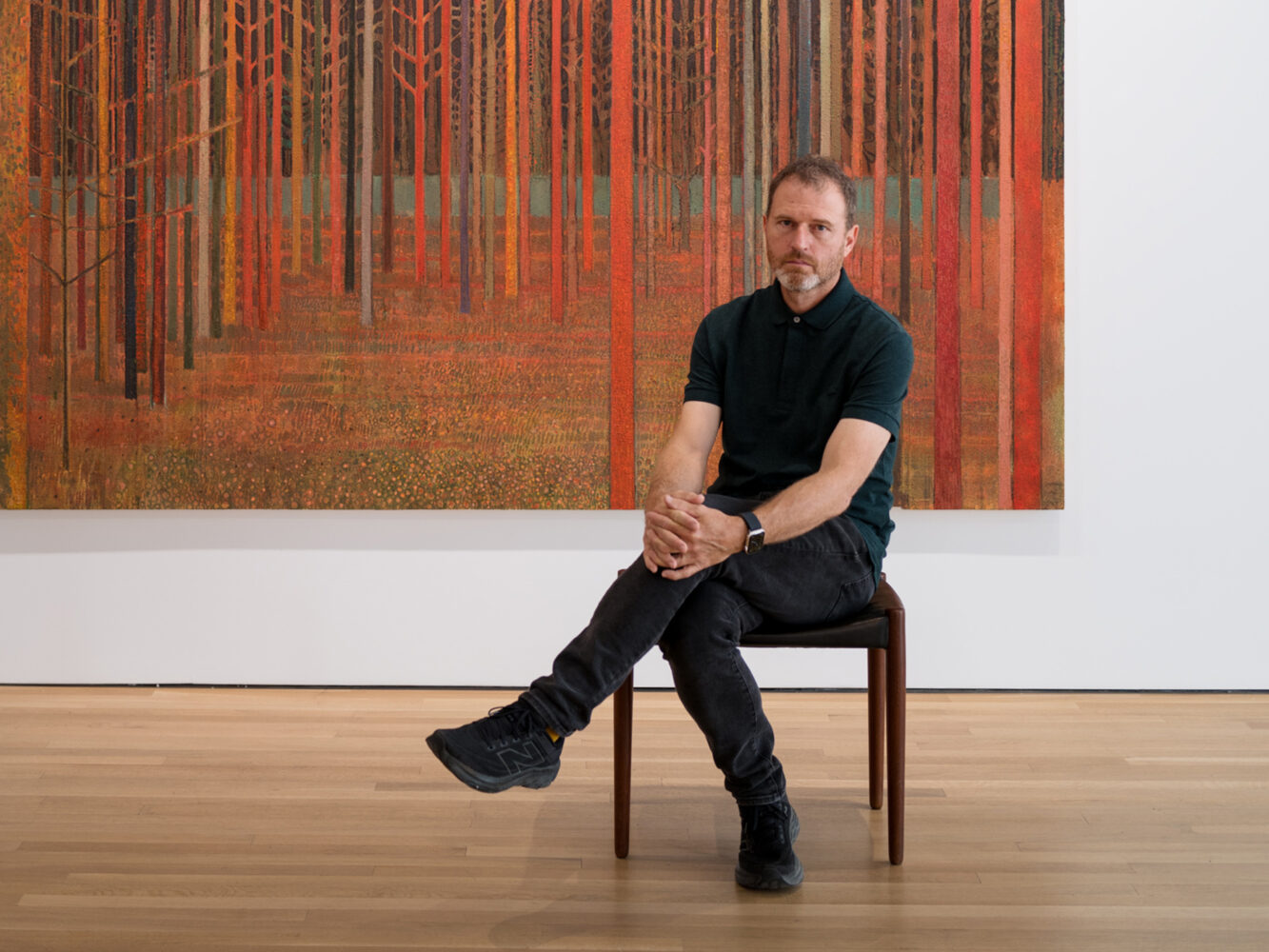
“Landscape has always been an ordering principle,” says London, Ontario-based painter Sky Glabush. “It is an underlying logic of space.” But there is an additional logic involved that has to do with the way language and image intersect in his imaginative process. In 1997 when he was an undergraduate at the University of Saskatchewan in Saskatoon, he was doing a double degree in English and the visual arts. He recalls that literature interested him more than art and he “stumbled into painting.” It turned out to be a fortunate fall.
What is clear, though, is that literature, especially poetry, has stayed with him. When he talks about painting, he will mention painters like Cézanne, Matisse and Rothko, but poets, including Al Purdy, Seamus Heaney and Emily Dickinson, naturally enter the conversation. It was through the poetry of Al Purdy that he came to the realization that the landscape of southern Ontario provided him with everything he needed to make paintings, and it was a poem by the Irish poet Seamus Heaney that gave him the language to talk about the “new calligraphy” in his paintings. From Emily Dickinson he borrowed “every wild bluebell,” which he then used as the name of a painting that he combined with looking at Van Gogh’s irises. Words and images in the same imaginative frame.